Views: 0 Author: Site Editor Publish Time: 2026-09-04 Origin: Site


Scaling a leathercraft business requires moving away from time-consuming hand-cutting. However, investing in the wrong equipment can quickly lead to ruined materials, toxic fumes, or bottlenecked production. Transitioning from basic hand tools to automated or mechanical cutting isn't just about speed. It involves precisely matching your new equipment to your specific material types. For instance, heavy vegetable-tanned leather reacts entirely differently under pressure than soft chrome-tanned hides. You must also evaluate your production volume and physical workspace constraints. Making an uninformed purchase can disrupt your entire manufacturing workflow. This guide provides an evidence-based framework to help you evaluate different machine categories. We will assess upfront pricing, examine operational expenses, and help you select a system delivering reliable ROI for your workshop.
Before purchasing any industrial equipment, you must establish clear production benchmarks. You cannot evaluate a machine solely on its spec sheet. You must align its capabilities against your daily workshop reality. Let us break down the core criteria.
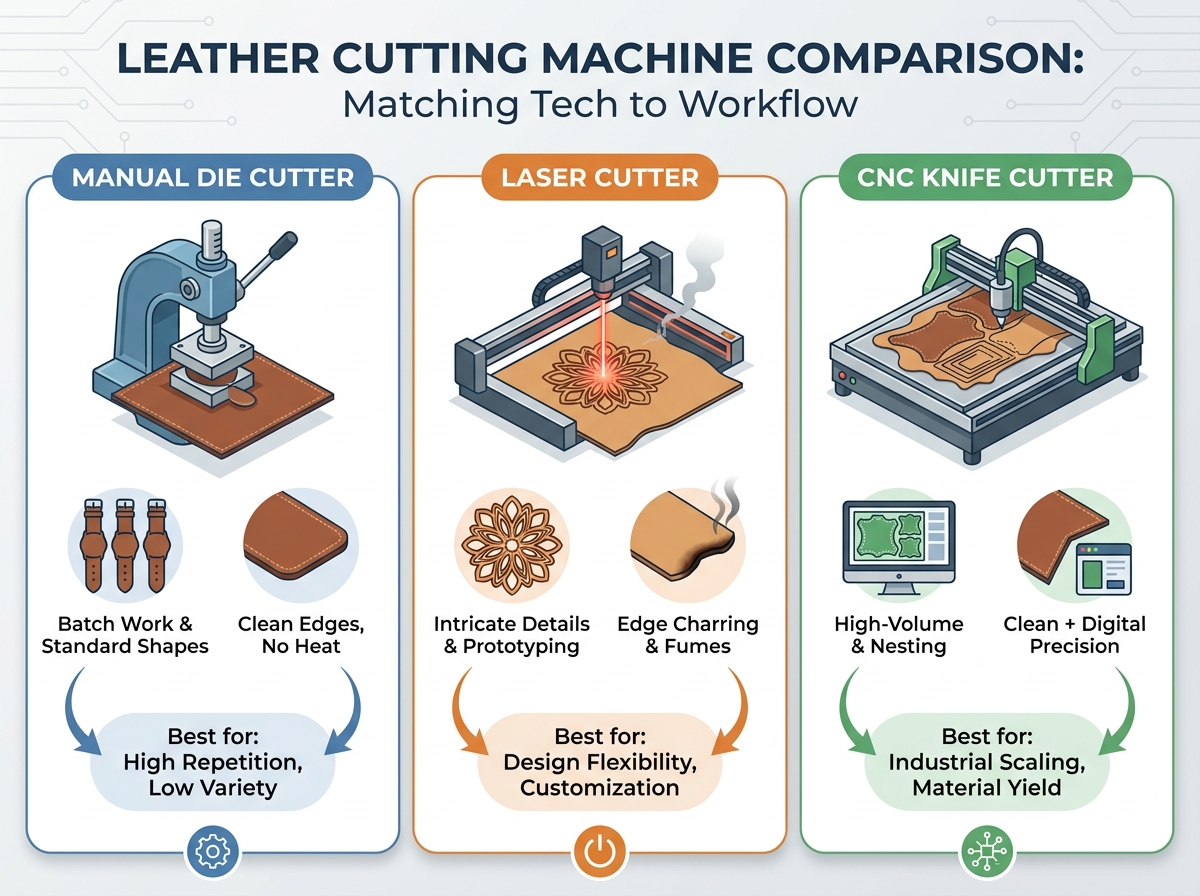
Mechanical presses represent the traditional backbone of leather goods manufacturing. They deliver immense force to slice through tough hides seamlessly. You will find them in almost every professional leather workshop globally.
How It Works: This equipment utilizes hydraulic, pneumatic, or hand-cranked pressure. The machine forces custom steel-rule dies straight through the material. Popular variants include swing-arm clicker presses and flatbed die cutters. You place the leather on a specialized poly board, position the die, and activate the press.
Best Business Use Case: We recommend a Manual Leather Cutting Machine for highly repetitive production. They excel at cutting standardized shapes continually. Watch straps, drink coasters, and uniform wallet panels are perfect examples. Once you own the die, you can stamp out hundreds of identical pieces hourly.
Pros (Features-to-Outcomes):
Cons & Limitations:
Digital fabrication has transformed custom leathercraft. Lasers provide a bridge between digital design software and physical leather goods. They offer incredible creative freedom for modern makers.
How It Works: A laser cutter uses a focused beam of intense light. We typically see CO2 or Diode laser types in workshops. This beam literally burns through the material. You control the entire path using vector-based design software like Adobe Illustrator or LightBurn.
Best Business Use Case: Lasers dominate intricate detailing tasks. They are excellent for rapid prototyping and engraving branding logos. Businesses frequently changing designs thrive here. You never need to buy physical dies for a new product launch.
Pros (Features-to-Outcomes):
Implementation Risks & Drawbacks:
When you outgrow manual presses but cannot tolerate laser charring, CNC knife systems bridge the gap. They represent the pinnacle of automated soft-goods manufacturing. These platforms deliver speed, precision, and perfect edges.
How It Works: This sophisticated leather cutting Machine uses computer-guided, rapidly vibrating mechanical blades. Manufacturers call them drag knives or oscillating knives. The machine slices through leather pinned down firmly by a powerful vacuum bed.
Best Business Use Case: CNC platforms dominate mid-to-large scale commercial manufacturing. You see them extensively in furniture upholstery shops. Automotive leather interior manufacturers rely on them exclusively. They handle full-sized hides with extreme efficiency.
Pros (Features-to-Outcomes):
Implementation Risks:
Equipment evaluation goes far beyond the sticker price. Do not evaluate a Leather Cutting Machine price solely on the initial invoice. A cheap machine often carries massive hidden operational expenses. You must map out all ongoing costs to understand your true return on investment.
Base Machine Cost vs. Operational Expenses: Initial procurement is just day one. Maintenance, consumables, and software fees accumulate quickly. Let us examine the specific hidden expenses tied to each machine category.
Hidden Cost Matrix:
| Machine Category | Primary Consumables | Maintenance Needs | Cost Predictability |
|---|---|---|---|
| Manual Clicker Press | Steel-rule dies, poly cutting pads | Hydraulic fluid checks, lubrication | Highly predictable |
| Laser Cutter | CO2 tubes, focal lenses, filters | Optics cleaning, exhaust clearing | Variable based on usage |
| CNC Oscillating Knife | Tungsten blades, vacuum seals | Software updates, rail greasing | Moderate to high |
ROI Calculation: Measure the machine's upfront price against the hourly labor saved in hand-cutting. Track the reduction in material waste via precise nesting software. Finally, calculate the newly unlocked ability to fulfill larger bulk contracts. A machine paying for itself through labor savings within 14 months represents an excellent investment.
Selecting a vendor requires strict due diligence. The industrial machinery market features widely varying quality tiers. Finding a reliable Leather cutting machine for sale means looking past flashy marketing brochures. You need tangible proof of performance.
Requesting Sample Cuts: Never purchase a commercial machine blindly. You must send the manufacturer scraps of your specific leather. Ask them to cut your designs and return the physical pieces. Inspect the edges closely for charring, compression, or fraying. If they refuse to provide samples, walk away immediately.
Vendor Support & Warranty: Assess the availability of domestic replacement parts. Investigate their technical support response times. A cheaper imported machine loses its value rapidly if a broken sensor halts production for three weeks. Production downtime destroys profit margins faster than equipment depreciation.
Software Compatibility: Ensure the machine's proprietary software integrates smoothly into your current workflow. It must accept files from your primary design programs. Common standards include Adobe Illustrator, AutoCAD, and LightBurn. File conversion headaches will drain your daily productivity.
The "best" leather cutting machine is entirely dependent on your primary bottleneck. There is no universal perfect tool. You must analyze your daily frustrations objectively to find the right solution.
If die costs are eating your margins, a digital laser or CNC is the next logical step. If edge-burn cleanup is slowing you down, a heavy-duty manual press or CNC knife is the superior choice. Upgrading your equipment should eliminate friction, not create new operational hurdles.
Your immediate next steps involve data collection. Document your top three most-cut patterns. Calculate your current manual cutting time for these items accurately. Finally, reach out to reputable manufacturers to request live demos or sample cuts based on those specific designs. Use hard data to drive your final procurement decision.
A: Yes, high-wattage CO2 lasers can easily cut through 8oz+ veg-tan leather. However, the thicker the leather, the more pronounced the edge charring and odor will be, requiring rigorous edge sanding and burnishing.
A: No. Manual and hydraulic clicker presses are purely mechanical/fluid-based and highly robust. Routine maintenance generally involves checking hydraulic fluid levels, lubricating moving parts, and replacing the poly cutting pads when they become heavily grooved.
A: A drag knife is pulled through the material like a traditional hobby blade, which works well for very thin leathers but can drag or bunch thicker hides. An oscillating knife vibrates up and down rapidly (like a jigsaw), allowing it to saw cleanly through thick, dense leathers without distorting the material.