Views: 0 Author: Site Editor Publish Time: 2026-06-04 Origin: Site


Scaling commercial operations inevitably hits a severe bottleneck. Manufacturers must eventually transition from manual techniques to automated systems. You face a challenging dilemma during this shift. Do you choose the traditional high-volume efficiency of physical presses? Or do you opt for the flexible precision of a CNC Leather Cutting Machine? Both technologies offer distinct operational advantages for different business models.
This article provides an objective, data-driven comparison to help you choose. We analyze initial capital expenditures, operational expenses, and changeover times. By evaluating these critical factors, operations managers can make commercially sound equipment investments. You will learn exactly how these systems impact material yield. We will also explore volume thresholds to guide your final choice.
Break-even thresholds: Die cutting dominates single-SKU runs exceeding 5,000 units, while digital cutting is optimal for high-mix, low-volume (HMLV) production.
Hidden costs: Die cutting incurs recurring tooling costs ($100–$300+ per die) and physical storage overhead; CNC requires a higher initial CAPEX but near-zero tooling replacement costs.
Material yield: CNC leather cutters paired with smart nesting software typically increase material utilization by 10% or more, critical for expensive genuine and PU leathers.
Agility: SKU changeovers take 2–5 minutes on a CNC machine compared to 30 minutes to several hours for die presses.
A traditional die cutting machine relies entirely on physical molds. These molds use custom-fabricated steel-rule or rotary dies to stamp out shapes. Hydraulic or mechanical presses force them through the material. They often apply massive pressure, ranging from 1 to 200 tons of force. The workflow reality demands extensive manual setup time. Operators must carefully align heavy molds. They must also calibrate the press for proper depth. This physical mechanism works best for single, repeated cuts on highly uniform materials.
A modern CNC leather cutter operates on entirely different principles. It uses digital CAD or CAM files instead of physical molds. Automated cutting heads glide rapidly across a porous vacuum bed. These modular heads carry oscillating knives or drag blades. No physical molds are required at any stage. This workflow relies on a standardized, highly repeatable 8-step process.
Operators load the raw material onto the vacuum bed.
Smart software performs digital nesting for optimal placement.
Overhead lasers provide projection verification to check layouts.
The machine executes precise automated cutting.
Modular tools handle punching holes or marking seams.
Operators quickly unload the finished pieces.
Let us compare the baseline performance of both technologies. You need to understand their setup times and precision capabilities deeply. The table below outlines these crucial technical differences.
Performance Metric | CNC Digital Cutter | Traditional Die Cutter |
|---|---|---|
Standard Setup Time | 2–5 minutes | 30+ minutes |
Cutting Precision | Up to ±0.01 mm | ±0.15–0.3 mm (varies by die wear) |
Tooling Requirement | Digital Files (No physical dies) | Physical Steel-Rule/Rotary Dies |
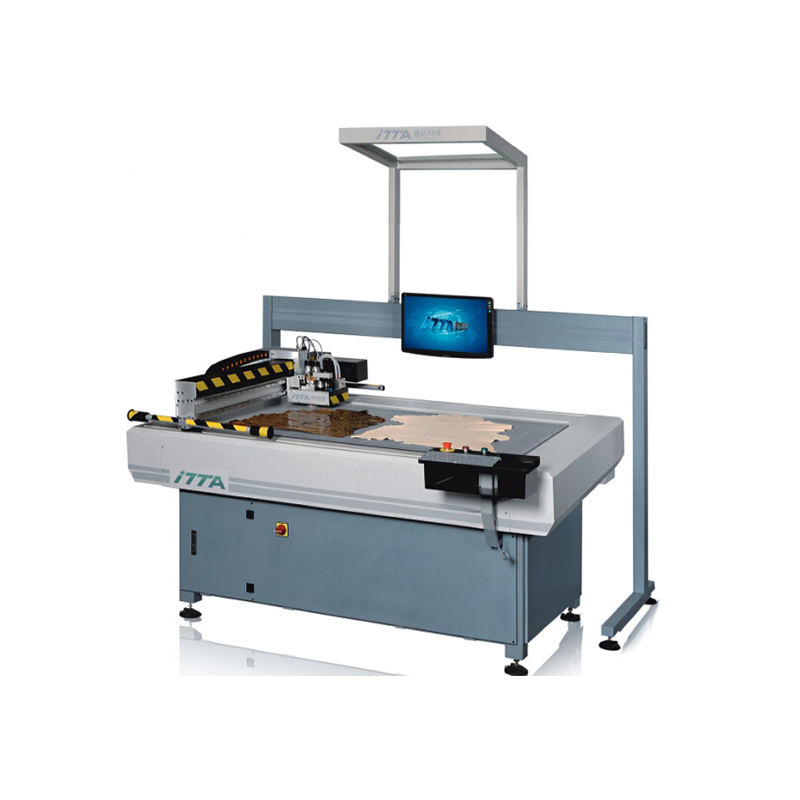
Many manufacturers believe raw speed is the only metric. Die cutters technically have a higher raw pieces-per-hour output. They excel at rapid, repetitive shapes. However, raw speed has limits in modern leather production. High-variance manufacturing changes this dynamic completely. Shoes, bags, and custom upholstery require constant daily design changes. Frequent modifications disrupt traditional continuous runs. When size variation increases, raw stamping speed quickly loses its advantage.
Digital technologies eliminate physical die-swapping entirely. This brings immense agility to your factory floor. Suppose a facility processes 5 to 10 different SKUs daily. The downtime of a die press quickly adds up. Each changeover can halt production for an hour or more. This idle time negates the rapid stroke-speed advantage. A CNC system switches SKUs in just 2 to 5 minutes. You simply load a new digital file and resume processing.
Raw leather and premium PU materials are notoriously expensive. High material waste destroys profit margins fast. Manual placement and die stamping often leave large unused gaps. Algorithmic nesting solves this expensive problem. Smart software dynamically fits patterns across the entire hide. It actively identifies and avoids pre-marked natural defects. This approach reduces scrap dramatically. Automated digital cutting typically boosts yield by over 10 percent. Such savings compound significantly over a fiscal year.
Initial capital expenditures vary significantly between the two systems. Die cutters have a lower initial machine purchase cost. This makes them highly accessible for baseline mass production. Smaller operations often start here to minimize upfront risk. CNC systems require a higher initial capital requirement. You might spend between $10,000 and $100,000+. The exact price depends on bed size and multi-tool configurations. However, this higher initial investment unlocks unmatched operational flexibility.
Operating expenses tell a different story over time. Die cutting hides significant recurring costs. You must procure new dies for every single design iteration. Physical dies suffer wear-and-tear and require periodic sharpening. You also pay for physical die storage infrastructure. Manual setup labor adds further ongoing expenses. CNC hidden costs are minimal by comparison. You primarily face the periodic replacement of consumable blades. Digital software updates also require occasional maintenance fees, but these remain predictable.
We must introduce the volume threshold to analyze financial viability. Consider production runs consistently under 5,000 units. Here, the recurring cost of die fabrication severely impacts your margins. Digital systems easily win in this high-mix scenario. Now consider massive, unchanged batches exceeding 10,000 units. The traditional press becomes highly profitable again. The amortized die cost per unit drops to pennies. Your specific daily volume ultimately dictates the better financial choice.
Cutting thin, rigid materials like cardboard is relatively simple. Thick, flexible materials present unique manufacturing challenges. Genuine leather and heavy PU stretch under tension. Multi-layered fabrics can shift unexpectedly during processing. Die presses handle uniform substrates reasonably well. However, they struggle with natural thickness variations. Advanced digital systems adapt to these irregularities easily. Industrial vacuum beds hold flexible hides firmly in place. This prevents unwanted shifting during high-speed operations.
Modular tooling provides incredible versatility on the factory floor. You can quickly switch cutting tools for different materials. This single machine can handle multiple distinct processes.
Pneumatic Oscillating Knives: Excellent for multi-ply tasks up to 20 layers. They handle dense materials easily.
Electric Oscillating Knives: Perfect for fast, single-ply cuts on softer hides.
Punching & Marking Tools: These integrate stitching hole punches directly into the workflow.
Industry community insights confirm these profound benefits. Integrating hole punches eliminates tedious post-processing edge work entirely. It also substantially reduces operator fatigue. Workers no longer spend hours manually punching stitching holes.
Use a quick evaluation lens to choose the right technology. Different materials demand different processing methods. Here is a summary chart comparing material compatibility directly.
Material Type | Ideal Technology | Core Reasoning |
|---|---|---|
Uniform, Thin Substrates (Plastics, Paper) | Die Cutting | Fast stamping, consistent thickness ensures clean, rapid cuts. |
Thick, Dense, or Variable Hides | CNC Cutter | Adapts to natural variations, prevents severe material distortion. |
Multi-layer PU Fabrics | CNC Cutter (Pneumatic) | High-frequency oscillation prevents edge fraying across multiple layers. |
Certain business profiles benefit immensely from digital workflows. Custom upholstery manufacturers are prime candidates. High-fashion bag and shoe prototyping labs also fit this profile perfectly. These operations often transition directly from manual methods. The key driver here is high design flexibility. You maximize expensive material yield effortlessly. You also achieve rapid prototyping without carrying heavy die costs. Investing in leather automation unlocks much faster time-to-market for new designs.
Other specific profiles should rely on legacy methods. Mass-market accessory manufacturers often prefer physical presses. Standardized gasket or uniform watch strap producers also rely on them. Their key driver is predictable, massive volume. They experience zero design variation over long product lifecycles. If you produce identical shapes daily, physical stamping remains highly efficient. The low initial cost also lowers the barrier to entry significantly.
Many modern facilities adopt a smart hybrid manufacturing approach. They use CNC systems for research and development. They deploy them for rapid prototyping and short pilot runs. Meanwhile, they route proven, high-volume hero SKUs to legacy die presses. This balances ultimate flexibility with high-speed throughput. You get the absolute best of both worlds. The hybrid approach optimizes both capital allocation and daily production limits.
There is no universally superior machine for every manufacturing floor. You must find the right equipment for your specific production model. Your final decision heavily hinges on your facility's daily SKU variance versus total volume output. High variance overwhelmingly favors digital methods. Static, massive volume favors traditional physical presses.
We strongly advise you not to under-spec your equipment during procurement. Always factor in a 20 to 30 percent capacity redundancy. This crucial buffer easily accommodates future business growth. It also helps manage unexpected seasonal production spikes effectively.
Take actionable steps before finalizing your investment. Calculate your annual die-replacement costs to understand your true operational expenses. Request a live material-cutting demonstration from your shortlisted vendors. Seeing your own materials cut verifies vendor claims. This ensures complete confidence in your final purchase decision.
A: Yes for high-mix manufacturers. Custom shops and prototyping labs often replace presses entirely. However, mass-producers of single, uniform shapes will likely retain their die presses. Traditional stamping still provides maximum raw output speed for unchanged, repetitive runs.
A: Smart software calculates the optimal layout computationally. It dynamically reduces gaps between patterns. It also actively avoids pre-marked flaws in natural hides. This automated process saves roughly 10 to 15 percent more material compared to traditional manual layouts.
A: Operators need basic CAD/CAM literacy. They must undergo training for file ingestion and machine calibration. Fortunately, modern touch-screen interfaces have significantly simplified the prepress workflow. Most workers adapt quickly within a few weeks of guided operation.
A: CNC blades are high-frequency consumables. You must replace them regularly depending on material hardness. Physical dies last much longer, often surviving 50,000 to 100,000 strikes. However, when a die eventually dulls or a design changes, replacing it costs exponentially more than a simple blade.