Views: 0 Author: Site Editor Publish Time: 2026-06-11 Origin: Site


Scaling upholstery production is rarely gated by consumer demand. Instead, manufacturers face a massive bottleneck in manual cutting. They also suffer from the high cost of material waste. When operators cut hides by hand, throughput drops and human error spikes. Upgrading to modern cutting automation requires moving past basic specification sheets. The right investment hinges on flaw detection accuracy. It also relies on software integration and actual throughput under continuous shifts. This article provides a definitive framework for evaluating industrial cutting systems. You will learn how to measure verifiable yield improvements. We also examine real-world capacity and help you navigate implementation realities seamlessly.
A high-performing furniture leather cutting machine relies as much on its visual projection and nesting system as it does on mechanical blade speed.
CNC oscillating knife technology is the industry standard for genuine upholstery leather cutting, eliminating the burnt edges and hardening associated with lasers.
ROI in mass production is primarily driven by material yield (saving 3-8% on genuine leather hides) rather than cycle time alone.
Evaluating a machine requires testing your specific hides to assess the vacuum hold-down efficiency and software handling of natural flaws.
Many factories attempt to adapt standard textile cutters for leather. This approach consistently fails in high-volume furniture manufacturing. Genuine and faux leathers present entirely different physical realities. Roll-fed synthetic polyurethane (PU) demands continuous conveyor systems. It feeds from a roll seamlessly. Conversely, genuine hides require flatbed digitization. This visual process maps irregular perimeters. Operators must identify natural scars before any blade touches the material.
You cannot cut large sofa panels on a compact apparel bed. Oversized hides need specialized projection zones. They also demand synchronized multi-head routing to maintain production speeds. When you optimize sofa leather cutting, material utilization dictates your gross margins. Poor yield rapidly degrades profitability. Every discarded inch of premium leather eats directly into your profits. Therefore, intelligent nesting acts as a baseline requirement. It is never just an optional software upgrade.
Buying based on mechanical speed instead of material yield.
Ignoring the time required for manual defect marking.
Using equipment designed for thin apparel fabrics on thick upholstery.
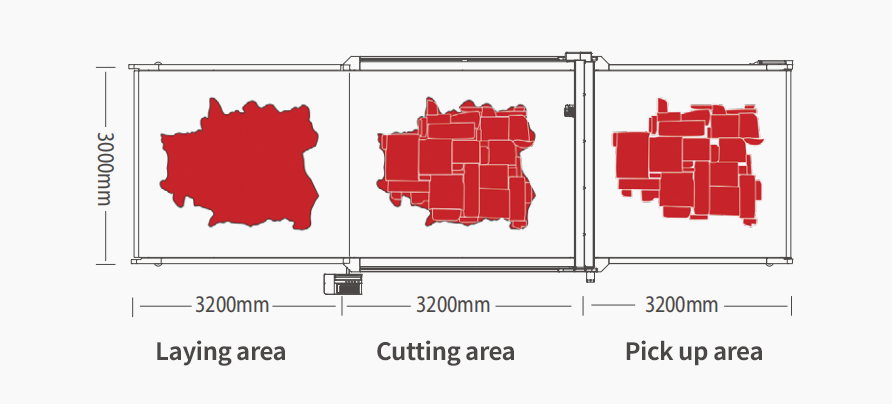
Furniture manufacturers generally choose between two primary cutting technologies. They evaluate CNC oscillating knives against laser systems. Each offers distinct capabilities, but one clearly dominates premium applications.
Feature | CNC Oscillating Knife | Laser Cutting System |
|---|---|---|
Cutting Mechanism | Mechanical high-frequency blade | Thermal laser beam |
Edge Quality | Pristine, soft, ready-to-sew | Charred, hardened, burnt odor |
Material Suitability | Thick genuine leather & multi-ply faux | Thin synthetics (unsuitable for genuine) |
Environmental Impact | Clean operation | Produces smoke, requires extraction |
Digital cutters use CNC oscillating knives to slice mechanically without heat. This method leaves pristine, ready-to-sew edges. Edge quality remains crucial for high-end furniture leather cutter applications. Oscillating blades seamlessly handle high-thickness multi-ply faux leather. They also effortlessly process dense single-ply genuine hides. The mechanical action prevents material distortion.
Laser systems boast incredibly high linear speeds. However, they create severe thermal damage on genuine leather. Lasers burn the material, causing charring and hardened edges. They also generate an unpleasant odor during processing. Hardened edges complicate the sewing process. Needles can break, and seams look unnatural. Consequently, lasers remain generally unsuitable for premium upholstery. In these high-end scenarios, seam quality remains paramount.
Genuine hides naturally contain bite marks, neck wrinkles, and grain variations. You must evaluate the camera and projection systems rigorously. The system must allow operators to quickly mark scars and grain variations. They do this before the software generates a cut path.
Look for dual-camera setups. High-end machines utilize cameras capable of capturing entire hides simultaneously. This capability prevents bottlenecks at the scanning stage. Efficient digitizing ensures continuous production flow. Operators simply outline the defect zones using a laser pointer or digital pen. The software instantly registers these exclusion zones.
Your production yield relies heavily on the algorithm driving the software. Assess the algorithm's capability to perform multi-hide nesting. This distributes sofa pattern pieces across multiple hides concurrently. A robust nesting system minimizes scrap significantly. It fits smaller components into the awkward edge spaces of irregular hides.
Verify if the software accounts for directional stretch. It must also handle grain matching automatically. These factors remain critical for furniture aesthetics. If patterns stretch incorrectly, the final sofa cushions will warp over time. Software must lock specific pattern orientations to match the natural stretch of the hide.
Large hides slip easily under heavy blade pressure. You must evaluate the partitioning of vacuum zones. Smart machines concentrate suction specifically where the cutting head currently operates. This targeted suction holds thick leather firmly in place. It prevents shifting during rapid direction changes.
Assess conveyor configurations carefully. Factories often cut synthetic leather rolls alongside genuine hides. The bed mechanics must support both static holding for hides and continuous feeding for rolls. A breathable, micro-porous cutting mat ensures even vacuum distribution.
Mass production requires quick tool-swapping capabilities. Operators often switch from a high-frequency oscillating blade for thick leather to a punch tool. They use the punch tool for tufting holes and decorative perforations. A multi-tool head reduces machine downtime.
Evaluate the active depth control mechanism. This technology prevents scoring the conveyor belt underneath. It also ensures clean cuts on varying hide thicknesses. Genuine leather thickness varies from the neck to the belly. Active depth control adjusts blade penetration dynamically.
Many buyers overlook the realities of factory implementation. You must scrutinize software integration and physical maintenance carefully. Proper planning prevents costly production delays.
The machine must integrate smoothly into your digital ecosystem. It needs to communicate with existing ERP systems directly. It also must support 3D CAD and pattern-making software natively. Ensure it handles DXF and PLT file formats without complex conversions. Direct integration eliminates manual data entry errors.
Operational efficiency depends on managing physical wear and tear. Blades, cutting mats, and vacuum pump filters require regular replacement. Clarify the expected lifespan of these consumables. Ask vendors for estimates based on a continuous 2-shift production environment. Frequent mat replacements disrupt production schedules. Quality consumables ensure consistent upholstery leather cutting performance over years of heavy use. Keep spare blades in stock to avoid sudden stoppages.
Advanced automation requires operators to transition from physical cutting to software management. They must interpret digital nests and manage machine alerts. Assess the vendor's service level agreement (SLA) for on-site training. You also need to evaluate the user interface intuitiveness. A complex UI delays operator onboarding. Vendors should provide comprehensive training programs. This ensures your staff maximizes the machine's capabilities quickly.
Selecting the right Furniture Leather Cutting Machine demands rigorous testing. Do not rely solely on marketing brochures. You must validate claims through direct testing.
Never buy based on theoretical brochure speeds. Require a vendor to process a batch of your own hides. This trial proves the claimed material yield percentage on your exact materials. Manufacturers often inflate yield numbers using perfectly shaped artificial hides. Real-world testing reveals the truth.
Compile a sample batch of your most irregular genuine hides.
Demand a live floor-to-floor processing test using your actual production DXF files.
Compare the digital nesting yields directly against your current manual cutting waste.
Calculate the actual floor-to-floor time. Measure the entire cycle: Scanning, Nesting, Cutting, and Sorting. Do not just measure the linear cutting speed. Real bottlenecks occur during offloading and sorting. A machine might cut rapidly but leave operators struggling to sort identical pieces.
Check the availability of domestic technicians in your region. Ask about response times for software troubleshooting. Ensure the vendor maintains an ample spare parts inventory locally. Downtime in mass production ruins profitability. Reliable support keeps your assembly lines moving.
Your decision matrix must prioritize material savings. Focus heavily on yield optimization through advanced software. Edge quality from an oscillating CNC head always outweighs raw machine speed. Treat this purchase as a software and workflow integration project. It is never just a simple hardware acquisition.
To move forward, compile a sample batch of your most difficult genuine hides. Initiate a documented hide-testing trial with shortlisted manufacturers. Finally, compare the digital nesting yields against your current manual cutting waste to verify operational improvements.
A: The return on investment typically takes 12 to 18 months. This rapid ROI is primarily driven by a 5% to 8% material savings on expensive genuine hides. In high-volume production, material yield improvements generate far more savings than simple labor reduction.
A: No. High-end CNC cutters feature modular conveyor belts. However, PU is cut from a continuous roll using a dynamic feed system. Genuine leather requires individual hide scanning and static cutting on the flatbed to manage natural flaws effectively.
A: Industrial systems require substantial infrastructure. Factories typically need robust 3-phase power and specific CFM requirements for high-capacity vacuum pumps. Facilities often overlook these prerequisites during initial planning. Always verify power and pneumatic specifications with the vendor before installation.
A: Software payment structures vary by vendor. Some offer perpetual licenses with initial purchases. Others use annual SaaS models requiring recurring payments. Always address what happens during major software updates and whether ongoing technical support requires an active subscription.